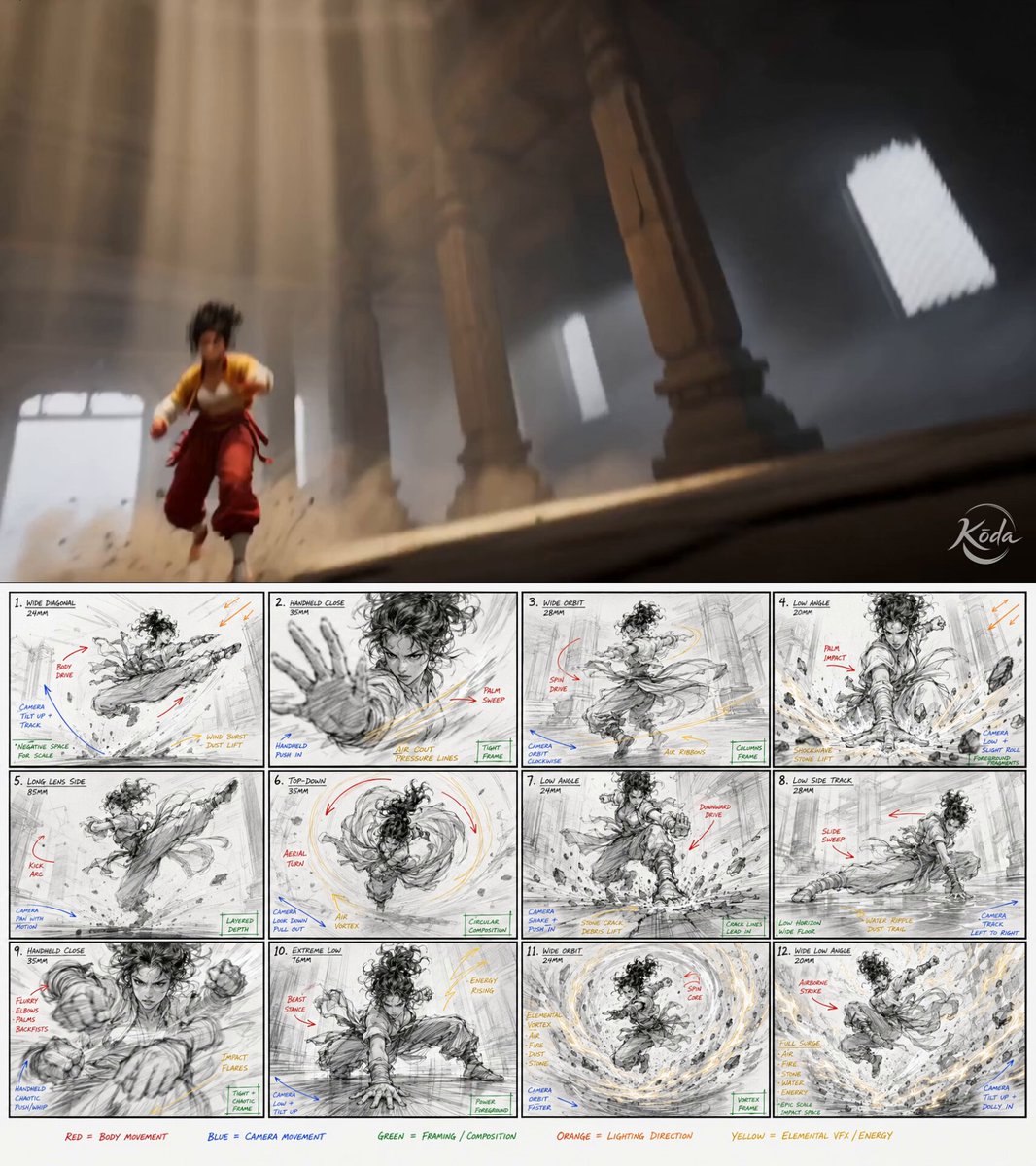
案例拆解:分镜表→视频的双段式工作流(GPT Image 2 + Seedance 2.0)
一句话:这条拆解一个「先用图像模型画 12 格分镜表,再把分镜表当硬约束喂给视频模型」的两段式流程,两端提示词都完整;适合已经能写单段视频提示词、但苦于长镜头动作跑偏、节拍失控的人读。
字段表
| 字段 | 值 |
|---|---|
| model | 第一段 GPT Image 2(生成分镜表),第二段 Seedance 2.0(生成视频);依据为作者原帖首行自述「GPT Image 2 + Seedance 2.0 Prompt Share」 |
| duration | 16.0 秒(提示词内写的是 15 秒,成片为 16.0 秒) |
| aspect | 成片竖版 853:960;分镜表本身是 16:9 横版(见第一段提示词) |
| seed 与可复现性 | 未记录;未验证——作者已发布成片,本库未复跑 |
| 成片链接 | 页面内嵌预览,见上方卡片与原帖 |
| 估算成本 | 待估(按官方单价,用成本计算器) |
| 作者与原链 | @aimikoda · https://x.com/aimikoda/status/2054460932068200517 |
prompt_en
原文转载(署名 + 原链齐全,见字段表)。以下三段依次为作者正文、评论区补充 1(分镜表提示词)、补充 2(视频提示词)、补充 3(作者对彩色标注的说明),均出自同一作者的同一条推文串:
GPT Image 2 + Seedance 2.0 Prompt Share

Mei Lin's Elemental Kung Fu Performance

Created on @mitte_ai

I'm experimenting with Laban right now. I think it helps make movements feel smoother and more expressive, but I still need to do more tests. For this one, I only added a small Laban section to the Seedance prompt.

Laban is a movement analysis system that describes motion through weight, time, space and flow.
GPT Image 2 Prompt for Storyboard:
Create a raw kung fu performance storyboard focused on extreme physical action. Use reference image for the character.
16:9 storyboard sheet, 12 cinematic panels. The actual storyboard drawings must be black and white only: rough pencil lines, minimal detail, fast gesture drawing energy, simple anatomy construction and strong silhouette readability. Keep the art loose and sketchy, like a real pre-production board.
Annotations must be color-coded so the model can separate instruction types: body movement in blue, camera movement in red, framing in green, lighting in orange. Keep annotation text short and legible.
The 12 panels must show a continuous kung fu performance with escalating intensity: stance, approach, first strike, block, counter, spin kick, ground work, recovery, aerial move, impact, final pose, settle.Seedance 2.0 Prompt:
Create a 15-second cinematic kung fu performance video.
Use @[image1] as the fixed character sheet reference. The character must strictly match the character sheet. Use @[image2] as the storyboard reference.
Follow the storyboard shot by shot as the main source for action order, camera rhythm, body movement, framing, movement direction, camera angles and visual progression. Do not reinterpret the actions, poses, camera angles or emotional progression.
Compress the full 12-beat sequence into 15 seconds with smooth continuous motion between beats.
Laban movement qualities: strong weight in strikes, sudden time in impacts, direct space in advances, bound flow in blocks and free flow in recovery.I also ended up color-coding the storyboard annotations because otherwise annotations were confusing the model. Different colors helped separate body movement, camera motion, framing and lighting directions from the actual environment and character drawings.prompt_zh
本库自译,属变体,未经生成测试,标未验证:
GPT Image 2 + Seedance 2.0 提示词分享

梅琳的元素功夫表演

在 @mitte_ai 上制作

我现在正在试验拉班(Laban)。我觉得它能让动作更流畅、更有表现力,但还需要做更多测试。这一条里,我只在 Seedance 提示词中加了很小一段拉班内容。

拉班是一套动作分析系统,用重量、时间、空间与流动来描述运动。
GPT Image 2 分镜表提示词:
创建一张粗放的功夫表演分镜表,聚焦极致的身体动作。角色请使用参考图。
16:9 分镜表版式,12 格电影感画格。分镜画本身必须只用黑白:粗糙的铅笔线条、最少的细节、快速速写的力度、简单的解剖结构与强烈可读的剪影。画风保持松散、草稿感,像一块真正的前期制作板。
标注必须用颜色编码,以便模型能区分指令类型:肢体动作用蓝色,运镜用红色,构图用绿色,灯光用橙色。标注文字保持简短易读。
这 12 格必须呈现一段连贯且强度递增的功夫表演:起势、逼近、首击、格挡、反击、旋踢、地面缠斗、恢复、腾空动作、命中、终式、收势。Seedance 2.0 提示词:
创建一段 15 秒的电影感功夫表演视频。
用 @[image1] 作为固定的角色设定表参考。角色必须严格匹配该角色设定表。用 @[image2] 作为分镜表参考。
逐镜跟随分镜表,以它为动作顺序、运镜节奏、肢体动作、构图、运动方向、机位角度与视觉推进的主要来源。不要重新演绎这些动作、姿势、机位角度或情绪推进。
将完整的 12 拍序列压缩进 15 秒,拍与拍之间保持平滑连续的运动。
拉班动作质感:出击时重量强,命中时时间突发,推进时空间直接,格挡时流动受束,恢复时流动自由。拆解说明
它做对的 5 件事
一、把叙事结构外包给图像模型,而不是塞进视频提示词。 「12 个动作节拍、强度递增」这种信息,直接写进视频提示词会变成一长串并列短语,模型很难分配时间与顺序。作者的做法是先让 GPT Image 2 把它固化成一张图:The 12 panels must show a continuous kung fu performance with escalating intensity: stance, approach, first strike, block, counter, spin kick, ground work, recovery, aerial move, impact, final pose, settle.——12 个节拍被逐一命名、逐一占格,顺序从文字变成了空间位置。视频模型此后读到的不是「一段描述」,而是「一份已经排好序的图」。这是本条最核心的机制:结构先落成像素,再交给下游。
二、彩色标注法,把「指令」与「画面内容」在视觉上分开。 Annotations must be color-coded so the model can separate instruction types: body movement in blue, camera movement in red, framing in green, lighting in orange. 作者在补充 3 里说得很直白:不做颜色编码时,标注会把模型搞混。原因不难理解——一张分镜图里同时躺着「要画出来的东西」和「关于怎么拍的说明」,模型没有先验去区分二者。颜色是最低成本的分类信号。这条经验的价值超出本案例:任何要交给模型读的中间图,都应该给元信息一个专属通道。
三、分镜的画风规定本身就是为「可机读」服务的。 black and white only: rough pencil lines, minimal detail, fast gesture drawing energy, simple anatomy construction and strong silhouette readability——注意这几个约束不是审美偏好:黑白让彩色标注得以跳出来(呼应第二点),minimal detail 和 strong silhouette readability 让每格只传递姿态信息、不夹带会被下游误当成风格指令的纹理细节。作者要的不是好看的分镜,是信噪比高的分镜。
四、第二段用禁止性措辞把参考图从「参考」升级为「硬约束」。 Follow the storyboard shot by shot as the main source for action order, camera rhythm, body movement, framing, movement direction, camera angles and visual progression. 先正面列出七项各自的权威来源,紧接着 Do not reinterpret the actions, poses, camera angles or emotional progression. 反面封口。「参考图」的默认语义是模糊的,模型很容易只取风格、自由重编动作;这两句是在说「这张图是剧本,不是灵感」。同段的 The character must strictly match the character sheet. 是同一手法用在角色上。
五、双参考图各绑一职,用 @[image1] / @[image2] 显式点名。 角色表管「长什么样」,分镜表管「怎么动、怎么拍」。两张图如果不点名,模型会把它们混成一锅笼统的视觉参考;点名之后每句约束都能挂到确定的那张图上。这是多图参考场景里的基本功,很多人给了两张图却只写一句「参考这些图」,等于白给。
它的可改进处
一、画幅在两段之间断裂,第二段完全没接住。 第一段明确要求 16:9 storyboard sheet,而成片是竖版(853:960)。第二段提示词里没有任何画幅声明——横构图的分镜格喂给竖版输出,每一格的构图关系都要被重新裁切,framing 这一项其实并没有被真正继承。自己写的时候:要么在第一段就让分镜格按目标画幅出(竖版成片就画竖版格),要么至少在第二段显式声明输出画幅,让模型知道该怎么转译。
二、12 拍压进 15 秒,但没有给任何一拍分配时长。 Compress the full 12-beat sequence into 15 seconds 把节奏分配整个交给了模型:平均每拍 1.25 秒,而 first strike(首击)和 settle(收势)显然不该等长。既然已经付出了做分镜表的成本,不如顺手在提示词里给关键拍标秒数区间(哪怕只标 3 到 4 个重拍),把节奏也变成受控变量。另外提示词写 15 秒、成片 16.0 秒,说明时长本身也不是被严格执行的量——未验证其偏差来源。
三、Laban 段是一句形容词罗列,既未受控也无法归因。 strong weight in strikes, sudden time in impacts, direct space in advances, bound flow in blocks and free flow in recovery 引入了一套描述动作质感的词汇体系(重量 / 时间 / 空间 / 流动),方向是对的——比「动作要有力」这类空话可操作得多。但它没有绑定到具体的节拍编号,而是笼统地覆盖全片;更麻烦的是,同一条片子里分镜表已经在强约束动作了,即便成片动作质感不错,也无从判断是 Laban 起了作用还是分镜表起了作用。作者本人也说 I still need to do more tests。要验证它,应当做只改 Laban 段、其余全部固定的对照测试。
四(附带)、链路长,任一段出错都要整条重来。 两段提示词都极长,中间还夹着一张必须质量达标的分镜表——分镜表画砸了,后面再精确的约束也是在放大错误。这套流程的适用面是「动作复杂、节拍多、值得一次性投入」的片子;拍三五秒的单一动作用它是亏的。
延伸阅读
- 《分镜级长提示词:按时间轴分段组织》
- 《角色一致性锁定写法》
- 《运镜指令词汇表 v0(中英对照)》